
Ever wonder why a good story pulls you in and leaves you wanting more?
Stories have always been a huge part of my life. I’m pretty sure my craving for a good yarn started before I could walk. My father was an amazing storyteller. He filled every sentence with juicy details and suspenseful moments that evoked awe and anticipation. Then he delivered each conclusion with warmth and authority. He told anecdotes from his childhood, recited poems by heart, and thrilled us with classic children’s fables. When he reached for a book on the shelf, my heart would race, and I’d hold my breath, waiting for the story to begin.
As soon as I could read on my own, I made friends with the librarians who delighted in helping me find my next new adventure. Racing on my bike to the library for my treasure hunt, I would stuff my basket to the brim with books and pedal furiously home. Opening them, I’d breathe in the mystery of where the paper and ink would transport me. Then it was time to cozy into just the right chair or secret nook and let the magic sweep me away. I often passed up playing with the kids outside, just to return to the wonderful world the book was creating. I sucked in those stories like lifesaving breaths.
Why did I like it so much? Why do humans crave this?
Turns out those childhood moments weren’t just magical—they tapped into something deeper: the biology of our brains.
Storytelling has been embedded in every human culture since the beginning of time. Throughout human evolution, stories were more than entertainment—they were survival tools. Our ancestors used narratives to share critical knowledge about overcoming threats, solving problems, and adapting to challenges. They didn’t have how-to manuals or search engines; they had oral traditions. These stories became the foundation of communities and culture, teaching future generations how to cope, how to triumph, and how to progress. That’s why even today, we expect every good story to have conflict, a turning point, and closure—our brains are built for it.
Humans have always been wired for stories. Storytelling is deeply ingrained in our biology. When we hear a story, multiple parts of our brain engage to help us remember, shape how we feel, and even influence the choices we make. From fireside chats thousands of years ago to TikTok videos today, stories remain one of the most powerful tools we have for connecting and learning.
Neuroscience researchers have shown that storytelling is the best way to capture people’s attention, imprint information into their memories, and resonate emotionally with them. The human brain is programmed to crave, seek out, and respond to well-crafted narrative—that’ll never change.
But why do we love a good story? What happens in the brain when we hear or read a compelling narrative?
When you dive into a story—whether you’re hearing it or reading it—your brain starts syncing up with the storyteller’s. Scientists call this “neural coupling,” but you might know it as “mirroring.” Research shows this isn’t just happening in one spot—it lights up multiple areas of your brain. And here’s the fun part: as you anticipate how the story will end, your brain rewards you with a hit of dopamine.
But that’s not all. The way a story paints pictures in your mind matters—a lot. The more vivid and detailed the imagery, the harder your brain works to bring it to life. That’s when the amygdala—a tiny bean-shaped control center tucked deep inside your brain—steps in. Its main job? Handling emotions, especially the big ones like fear, excitement, and stress. Think of it as your brain’s “emotional radar,” scanning for anything that feels important and tagging those moments, so you remember them. When something hits hard emotionally, the amygdala makes sure those moments are unforgettable.
And when you’re really into it? Your brain starts releasing oxytocin, the “connection” chemical, which makes you feel closer to the characters—sometimes closer than to real people.
With the combination of oxytocin, dopamine, and cortisol—the stress hormone that keeps you alert—you hang on every twist and turn. Suddenly, you’re hooked. That’s why we tell ourselves “just one more chapter” and end up reading or binge-watching into the wee hours when we should be catching that much-needed shut-eye instead.
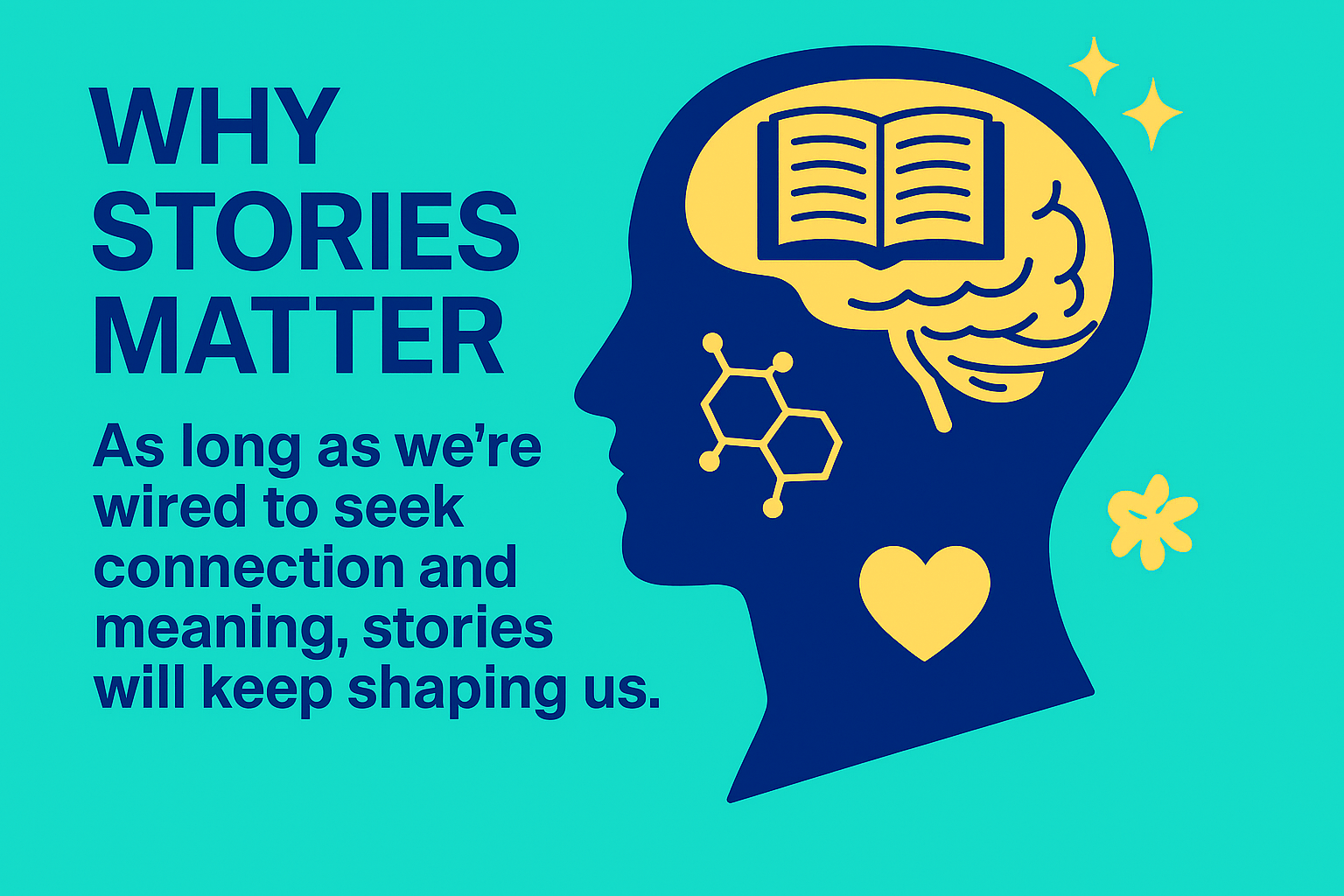
That’s the biological power behind stories, and why cultures have relied on them for millennia. As long as we’re wired to seek connection and meaning, stories will keep shaping us—feeding our brains, sparking creativity, and changing the way we see the world.
So next time you give in to the guilty pleasure of escaping into a great story while chores pile up, remember—it’s not weakness, it’s biology.
 Jennifer L. Park, MBA